

(2001) Olympia Hotel
client : Confidentialtypology : Hospitality
services : Architecture
where : Port Harcourt, Nigeria
Project Overview: 5-Star Boutique Hotel, Port Harcourt
Situated just minutes from the commercial and cultural core of Port Harcourt, this 300-key five-star boutique hotel is envisioned as a commanding new presence in the city’s urban fabric. Conceived for the discerning international business traveler, the development blends architectural gravitas with contextual sensitivity—delivering a sophisticated hospitality experience rooted in both global standards and regional resonance.
Architectural Character
Assertive yet refined, the architectural language is one of contrast and clarity. A central stepped volume—clad in silver-reflective glazing—rises in rhythmic terraces, framing sweeping views over the city and port. This geometric core is flanked by monolithic stone towers that echo the permanence of civic architecture while creating a powerful symmetrical composition.
A steel-and-glass porte-cochère anchors the entry sequence with ceremonial intent, projecting outward as a sculptural canopy that announces arrival. Vertical flags, palms, and linear landscaping soften the building’s formal rigor, while also signaling its status as a diplomatic and corporate hub.
Functional Zoning
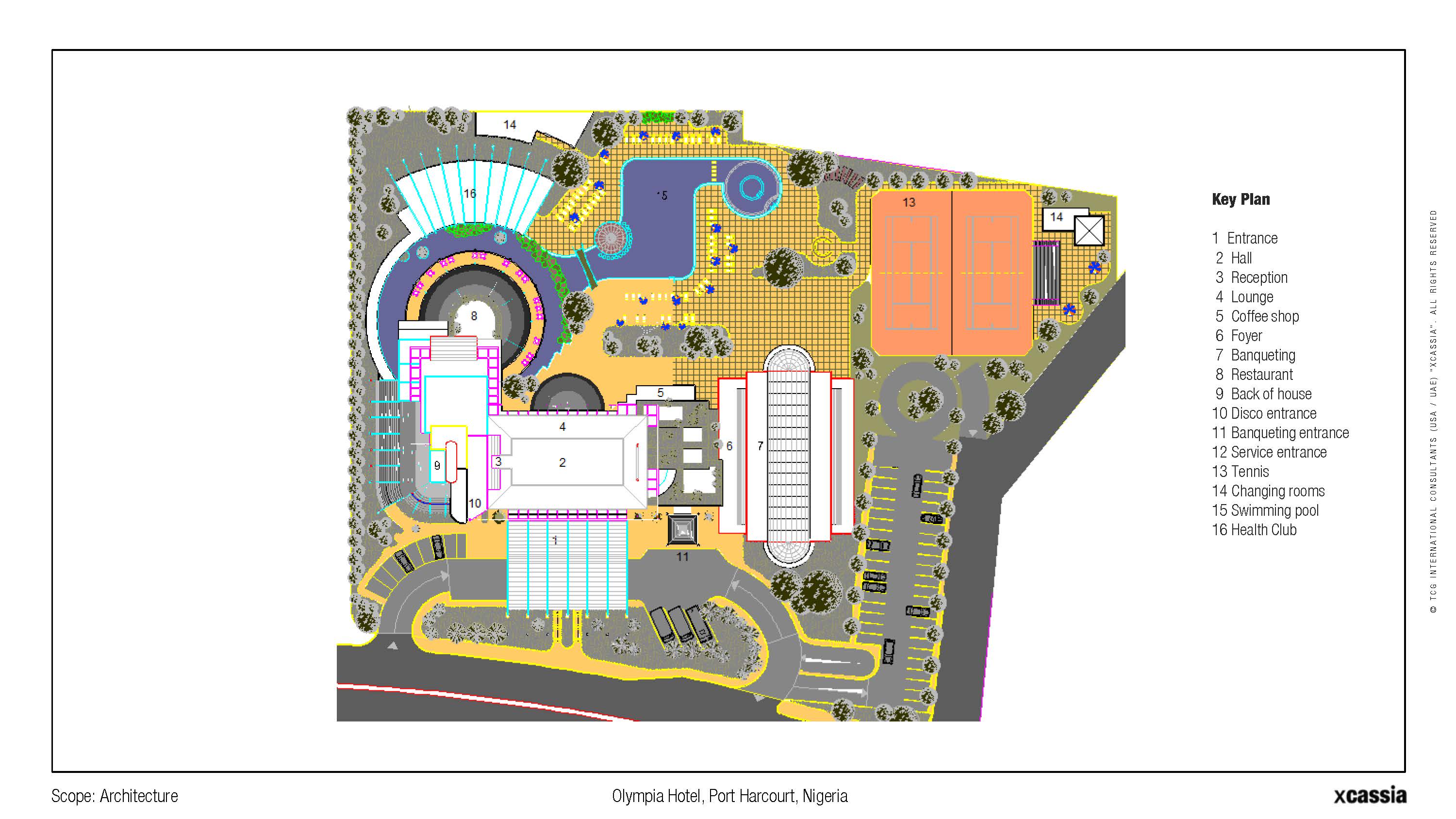
Programmatically, the project is rigorously organized to support parallel operational streams. Independent entrances are provided for the hotel, banqueting center, and wellness facilities, ensuring seamless circulation, security, and guest experience. This strategic separation allows the various components to operate autonomously or in synergy, depending on event scale and function.
The podium-level banquet hall—designed to accommodate up to 1,000 guests—extends onto the adjacent health club terraces and landscaped gardens. This creates an adaptable indoor-outdoor venue ideal for large gatherings, receptions, and cultural events, particularly suited to Port Harcourt’s warm tropical climate.
Landscape & Environmental Response
Landscape design is integral to the hotel’s architectural expression and environmental responsiveness. Native flora, palm-lined boulevards, and shaded pedestrian corridors provide not only aesthetic relief but also passive cooling, mitigating solar heat gain and enhancing microclimatic comfort. Elevated planting along terraces and rooftop gardens further ties the building to its lush equatorial setting, offering moments of quiet respite within the urban context.